
Table of Contents
Commercial activity beyond primary professional work represents a significant dimension of recognition-oriented careers. Celebrity business ventures describe the range of commercial enterprises, ownership positions, and business associations that publicly recognized individuals engage in alongside or separate from their primary professional activities.
Understanding celebrity business ventures requires examining how these enterprises are structured, what forms they take, and how they function within the broader context of public-facing professional careers. This examination focuses on structural and categorical considerations rather than individual outcomes.
What “Celebrity Business Ventures” Means

Celebrity business ventures refers to commercial enterprises in which publicly recognized individuals hold ownership stakes, partnership positions, or significant associational roles. The term encompasses a range of business activities that extend beyond primary professional work in recognition-oriented fields.
The concept addresses business involvement as a category of professional activity. When individuals known for entertainment, athletics, or other visibility-dependent professions participate in commercial enterprises, those enterprises fall within the celebrity business ventures framework.
This concept spans diverse business types and involvement structures. From consumer products to service businesses, from full ownership to limited association, celebrity business ventures encompass varied commercial arrangements unified by the involvement of publicly recognized individuals.
The ventures may relate to an individual’s primary professional field or operate in entirely separate industries. Some ventures leverage professional recognition directly while others exist independently of the recognition that accompanies primary careers.
Understanding celebrity business ventures requires distinguishing them from primary professional income activities. While primary professional work generates earnings through direct professional service, ventures represent separate commercial enterprises with their own operational structures.
The concept also differs from endorsement or promotional relationships. Celebrity business ventures involve ownership or substantive business participation rather than simply lending recognition to others’ enterprises for compensation.
Why Celebrities Engage in Business Ventures

Multiple factors explain participation in business ventures among publicly recognized individuals. These factors relate to professional and structural considerations rather than personal preferences.
Professional Capacity Extension
Business ventures extend professional capacity beyond direct service provision. Primary professional work in recognition-oriented fields often depends on physical capacity, age, or continuous active engagement. Ventures provide professional activity that operates differently.
This extension diversifies professional engagement across activity types. Rather than concentrating all professional activity in recognition-dependent work, ventures create additional professional domains.
The extension addresses capacity limitations inherent in primary professional work. Physical performance, creative output, and competition-based professions all involve capacity constraints that ventures may not share.
Recognition Utilization
Public recognition creates potential value in business contexts. The visibility and audience connection that accompanies recognition-oriented careers may have applications in commercial settings.
Ventures provide mechanisms for utilizing recognition in business contexts. The attention and credibility associated with public recognition may support commercial activities in ways applicable to venture success.
Recognition utilization represents a structural opportunity that recognition-oriented careers create. The existence of this opportunity explains venture participation as a rational response to available resources.
Temporal Considerations
Primary professional careers in recognition-oriented fields often have limited duration characteristics. Performance-based, competition-based, or youth-oriented careers may have natural span limitations.
Ventures may operate on different temporal scales than primary careers. Business enterprises can potentially extend beyond primary career activity periods.
These temporal considerations make ventures attractive as complementary professional activities. The potential for different duration characteristics explains interest in establishing ventures alongside primary work.
Professional Identity Extension
Business participation extends professional identity beyond primary field designation. Individuals known for particular professional activities may develop additional professional dimensions through venture involvement.
This identity extension creates professional breadth beyond singular field association. Ventures provide basis for professional recognition in additional domains.
Professional identity considerations explain venture participation as identity-expanding activity. The desire for broader professional definition motivates engagement in diverse commercial activities.
Types of Business Ventures Associated With Celebrities
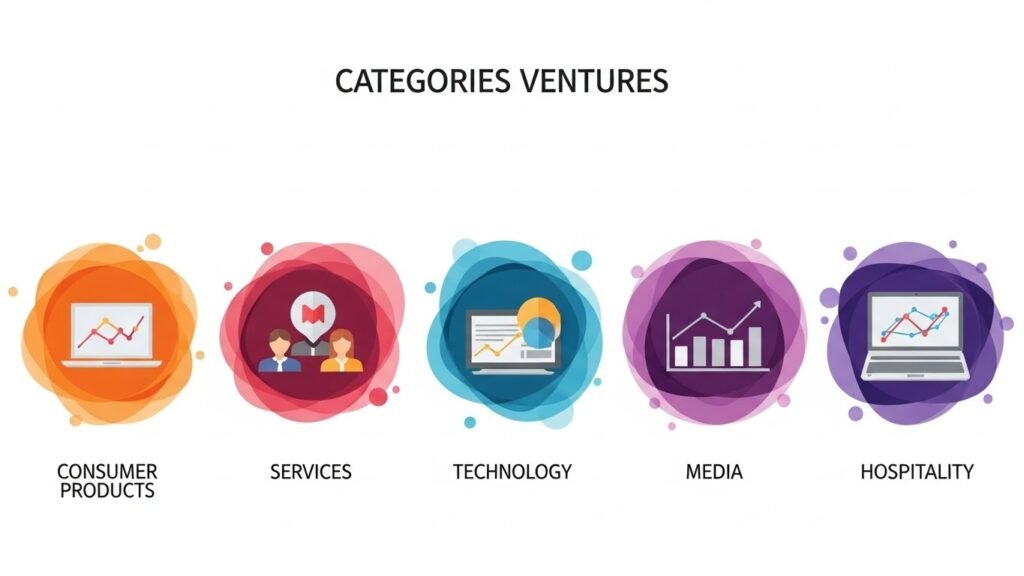
Celebrity business ventures span numerous business types and industries. Categorizing these venture types reveals the range of commercial activities involved.
Consumer Product Ventures
Many celebrity business ventures involve consumer products. Goods sold to end consumers represent a common venture type.
Consumer product ventures span numerous categories including apparel, beauty products, food and beverage, home goods, and various other product types. The diversity of consumer markets creates diverse venture opportunities.
These ventures involve product development, manufacturing relationships, distribution arrangements, and retail or direct-to-consumer sales. The operational complexity varies based on product type and scale.
Service and Experience Ventures
Service-based businesses represent another venture category. Ventures providing services rather than physical products constitute distinct business types.
Service ventures may include hospitality, entertainment venues, fitness or wellness services, education, and various professional services. These ventures deliver experiences or services rather than tangible goods.
Service ventures typically require different operational structures than product ventures. Location-based service delivery, personnel requirements, and experience quality management distinguish these venture types.
Media and Content Ventures
Ventures focused on media creation and distribution represent a category related to but distinct from primary entertainment work. Production companies, publishing ventures, and media platforms constitute media-focused ventures.
These ventures may produce content created by the celebrity or content involving other creators. The venture structure separates from individual creative work to encompass broader content enterprise.
Media ventures involve rights management, production operations, distribution relationships, and content development. They function as business enterprises distinct from individual creative output.
Technology and Digital Ventures
Technology-focused ventures address digital products, platforms, or technology-enabled services. Software applications, digital platforms, and technology companies represent this venture category.
Technology ventures may leverage recognition for user acquisition or operate independently of recognition-based advantages. The venture type encompasses diverse technology applications.
These ventures typically require specialized technical capabilities beyond recognition-related advantages. Technology expertise and development capacity are necessary for technology venture operations.
Hospitality and Real Estate Ventures
Hospitality and real estate ventures involve property-based businesses. Hotels, restaurants, entertainment venues, and real estate development constitute this category.
These ventures are asset-intensive and location-dependent. Physical property requirements distinguish them from ventures operating without significant real estate components.
Hospitality ventures involve operational complexity including property management, service delivery, and location-specific market factors.
Ownership Roles Versus Partnership Roles

Celebrity business ventures involve different structural positions. The distinction between ownership and partnership roles affects how ventures function.
Full Ownership Structures
Full ownership involves complete or majority control of venture enterprises. In full ownership structures, the celebrity holds dominant or exclusive equity position.
Full ownership provides maximum control over venture direction and operations. Decision authority concentrates with the owner rather than distributing across multiple parties.
This structure also concentrates risk and responsibility. Full ownership means undiluted exposure to venture outcomes alongside undiluted control.
Full ownership typically requires greater resource commitment. Capital requirements, operational involvement, and organizational development responsibilities fall to the owner.
Partnership Structures
Partnership arrangements distribute ownership across multiple parties. Celebrity participation occurs alongside other investors, operators, or partners.
Partnerships may involve operational partners who provide business expertise, financial partners who provide capital, or strategic partners who provide industry relationships. Different partnership types serve different venture needs.
Partnership structures divide both control and risk. The celebrity’s position represents one component of multi-party ownership rather than sole control.
These structures may provide access to capabilities not otherwise available. Partners may contribute expertise, resources, or relationships that complement recognition-based contributions.
Equity Stake Variations
Within both ownership and partnership structures, equity stake levels vary. Majority stakes, minority stakes, and various intermediate positions create different ownership profiles.
Stake levels affect control, risk exposure, and resource requirements. Larger stakes typically involve greater control and exposure while smaller stakes involve less of both.
The appropriate stake level depends on venture characteristics and participation intentions. Different ventures and different participation types warrant different stake structures.
Active Involvement Versus Passive Association

Celebrity business ventures vary in the degree of operational involvement they require. This distinction significantly affects how ventures function.
Active Operational Involvement
Some ventures involve significant operational participation. Active involvement means engagement in venture operations, decision-making, and management activities.
Active involvement may include strategic direction, operational oversight, creative contribution, or management participation. The specific involvement form depends on venture type and individual capabilities.
This involvement level requires time, attention, and capability investment. Active participation creates demands that must be balanced against other professional activities.
Active involvement may contribute value beyond recognition association. Substantive participation in venture operations adds contribution dimensions beyond visibility-related benefits.
Limited Operational Involvement
Other ventures involve limited operational participation despite ownership stakes. Limited involvement means ownership or association without significant operational engagement.
Limited involvement structures rely on professional management and operational partners. The celebrity contributes ownership stake and potentially recognition association while others handle operations.
This arrangement suits situations where operational expertise lies elsewhere or where time constraints prevent active participation. The venture functions through professional management rather than owner operation.
Limited involvement reduces time demands while maintaining ownership position. The tradeoff involves reduced operational control in exchange for reduced operational responsibility.
Advisory and Governance Roles
Intermediate involvement levels include advisory or governance participation. Board membership, advisory relationships, or strategic consultation represent involvement between active operation and passive ownership.
These roles provide input on significant decisions without requiring operational management. Strategic direction and major decisions involve celebrity participation while daily operations do not.
Advisory and governance roles suit situations requiring visibility involvement without operational capacity. The arrangement provides oversight without management responsibility.
Brand-Linked Ventures Versus Independent Ventures

Celebrity business ventures differ in their relationship to the celebrity’s public recognition. This distinction affects venture structure and operation.
Recognition-Linked Ventures
Some ventures directly incorporate the celebrity’s name, likeness, or professional recognition. These ventures explicitly connect to the celebrity’s public identity.
Recognition-linked ventures leverage recognition as a primary venture asset. The association with the celebrity constitutes a core component of venture value and market position.
These ventures depend on continued recognition value. Changes in public standing may directly affect venture position in ways that independent ventures would not experience.
Recognition-linked ventures typically require authentic connection between celebrity and venture. Audience perception of genuine involvement affects venture credibility and market acceptance.
Independent Ventures
Other ventures operate independently of celebrity recognition. These ventures may have celebrity ownership without public association or may operate in categories unrelated to the celebrity’s public identity.
Independent ventures succeed or fail based on venture merits rather than recognition association. The celebrity’s public standing does not directly determine venture market position.
This independence may provide stability against recognition fluctuations. Ventures operating separately from public identity avoid exposure to recognition-based risks.
Independent ventures may also involve different market dynamics. Venture evaluation occurs based on business fundamentals rather than celebrity association.
Hybrid Structures
Many ventures combine recognition linkage with independent operation. The celebrity association provides initial visibility while venture quality determines ongoing market position.
Hybrid structures attempt to capture recognition benefits while developing venture-specific value. Initial recognition advantage supports market entry while ongoing quality supports retention.
These structures require both recognition and operational strength. Neither element alone suffices for ventures depending on both dimensions.
Short-Term Projects Versus Long-Term Business Ventures

Temporal scope distinguishes different types of celebrity business ventures. Duration characteristics significantly affect venture structure.
Time-Limited Projects
Some ventures have defined endpoints or limited operational periods. Collaborations, seasonal ventures, or project-based businesses constitute time-limited ventures.
Time-limited ventures involve reduced long-term commitment. Participation ends when project duration concludes rather than requiring indefinite engagement.
These ventures suit situations where extended commitment is not desired or feasible. The bounded nature limits exposure while also limiting long-term opportunity.
Time-limited ventures may serve exploratory purposes. Testing interest or capability in business areas before longer commitment represents a function of time-limited engagement.
Ongoing Enterprise Ventures
Other ventures are structured as ongoing enterprises without predetermined endpoints. Businesses intended for continued operation constitute ongoing ventures.
Ongoing ventures require sustained attention and development. Building enterprises intended for extended operation involves different commitment than time-limited projects.
These ventures may develop significant organizational infrastructure. Personnel, systems, and operational capabilities develop over time in ongoing ventures.
Ongoing ventures involve extended relationship between celebrity and enterprise. The association continues as long as the venture operates and ownership position maintains.
Duration Evolution
Ventures may evolve in duration characteristics over time. Projects may develop into ongoing enterprises while ongoing ventures may conclude or transition.
Initial venture structure does not necessarily determine final form. Duration evolution reflects venture development and changed circumstances.
Understanding celebrity business ventures includes recognizing temporal flexibility. Initial characterization may not predict eventual duration outcomes.
Risks and Limitations of Celebrity Business Ventures

Celebrity business ventures involve risks and limitations that affect venture viability. Recognition of these factors provides balanced understanding.
Operational Capability Requirements
Business ventures require operational capabilities that may not align with recognition-based expertise. Primary professional skills in recognition-oriented fields do not automatically transfer to business operations.
Capability gaps may limit venture effectiveness. Without appropriate operational expertise, ventures may underperform relative to potential.
This limitation necessitates either capability development or reliance on partners and managers with required expertise. Neither solution eliminates the underlying capability challenge.
Attention and Resource Constraints
Ventures compete for attention with primary professional activities. Time and focus allocated to ventures reduces availability for other professional work.
Resource constraints limit venture scope and number. Capital, time, and attention available for ventures have practical limits.
These constraints require prioritization among venture opportunities and between ventures and primary work. Unlimited venture expansion is not feasible given resource limitations.
Reputation Interdependence
Recognition-linked ventures create reputation interdependence. Venture performance may affect public perception while public perception may affect venture performance.
This interdependence creates risk in both directions. Venture problems may create recognition problems while recognition problems may create venture problems.
Managing reputation interdependence requires attention to both venture and public standing. Neither can be managed entirely independently when linkage exists.
Market and Operational Risks
Standard business risks apply to celebrity ventures. Market conditions, competitive dynamics, operational challenges, and economic factors affect ventures regardless of ownership.
Celebrity involvement does not eliminate ordinary business risk. The same factors that affect other businesses affect celebrity ventures.
These risks may be underestimated when recognition-based advantages are overemphasized. Venture success requires managing standard business factors alongside recognition-related dimensions.
Common Misconceptions About Celebrity Business Ventures

Several misconceptions affect understanding of celebrity business ventures. Addressing these misconceptions supports accurate comprehension.
Automatic Success Assumptions
Assumptions that celebrity ventures automatically succeed overstate recognition-based advantages. Venture outcomes depend on business factors beyond recognition association.
Recognition provides potential advantages but does not guarantee results. Market acceptance, operational execution, and competitive dynamics determine outcomes.
Understanding celebrity business ventures requires recognizing recognition limits. Association does not ensure success despite potential benefits.
Passive Ownership Assumptions
Assumptions that celebrities merely attach names to others’ businesses understate involvement variety. Involvement levels range from minimal to extensive across different ventures.
Some ventures involve substantial celebrity participation beyond recognition lending. Creative input, strategic direction, or operational involvement may occur.
Accurate understanding requires recognizing involvement diversity. No single involvement model characterizes all celebrity business ventures.
Expertise Assumption
Assumptions that recognition-based success indicates business expertise conflate different capability types. Primary professional achievement does not automatically indicate business capability.
Business ventures require business capabilities that may or may not accompany primary professional skills. Expertise in recognition-oriented fields does not ensure expertise in business operations.
This distinction explains why some ventures underperform despite celebrity involvement. Capability gaps may exist despite primary professional achievement.
Uniformity Assumptions
Assumptions that celebrity ventures are uniform overlook venture diversity. Significant variation exists in venture type, structure, involvement, and relationship to recognition.
Understanding celebrity business ventures requires recognizing this diversity. Categorical generalizations may not accurately describe specific venture arrangements.
Venture-specific analysis provides more accurate understanding than category-wide assumptions. Individual ventures have specific characteristics that general descriptions may not capture.
Conclusion
Celebrity business ventures represent commercial enterprises involving publicly recognized individuals through ownership, partnership, or significant association. These ventures extend professional activity beyond primary recognition-oriented work into distinct commercial domains.
Multiple factors explain venture participation including professional capacity extension, recognition utilization, temporal considerations, and professional identity expansion. These structural factors explain venture engagement patterns.
Venture types span consumer products, services, media, technology, and hospitality among other categories. This diversity reflects the range of commercial opportunities available.
Ownership versus partnership structures distribute control and risk differently. Full ownership concentrates both while partnerships divide them among multiple parties.
Active versus passive involvement describes operational participation variation. Active involvement requires time and capability investment while passive association relies on professional management.
Brand linkage versus independence describes the relationship between ventures and celebrity recognition. Recognition-linked ventures depend on public standing while independent ventures operate separately.
Temporal scope ranges from time-limited projects to ongoing enterprises. Duration characteristics affect commitment requirements and venture development patterns.
Risks and limitations include capability requirements, resource constraints, reputation interdependence, and standard business risks. These factors affect venture viability regardless of celebrity involvement.
Common misconceptions include automatic success assumptions, passive ownership assumptions, expertise conflation, and uniformity assumptions. Accurate understanding requires recognizing these potential errors.
Celebrity business ventures, understood as a category of commercial activity involving publicly recognized individuals, represent a significant dimension of professional engagement in recognition-oriented careers that operates according to identifiable structural patterns.