
Table of Contents
Maintaining motivation over long, highly visible careers is a complex psychological challenge. Public figures operate in environments defined by constant evaluation, intense competition, and unpredictable external pressure. Understanding how celebrities stay motivated requires examining the internal systems that allow them to sustain effort, purpose, and engagement despite fame-related volatility.

Unlike short-term motivation driven by novelty or excitement, celebrity motivation must function as a long-term stabilizing force. It supports consistent performance, emotional regulation, and professional longevity in recognition-based careers.
What Motivation Means in High-Visibility Careers

In public-facing professions, motivation is not simply enthusiasm or ambition. It refers to the internal capacity to remain engaged with demanding work over extended periods, even when external rewards fluctuate.
For celebrities, motivation operates under unique conditions:
- Public approval is unstable
- Criticism is amplified
- Success does not guarantee security
- External validation is inconsistent
As a result, sustainable motivation must rely on internal psychological structures, not temporary emotional states.
Core Psychological Frameworks That Support Celebrity Motivation

Autonomy, Competence, and Meaningful Engagement
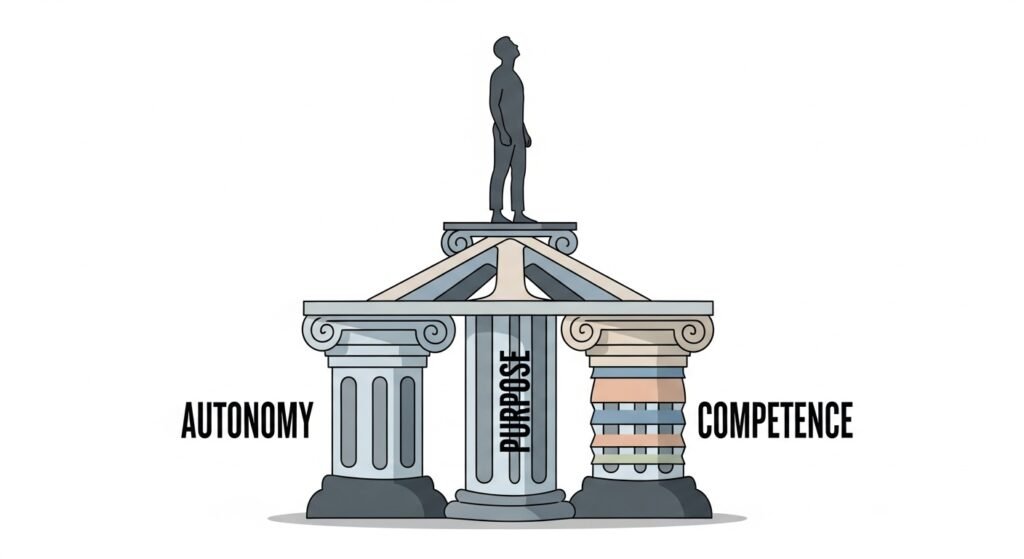
One of the most widely supported explanations for sustained motivation is the fulfillment of three psychological needs:
- Autonomy – experiencing choice and self-direction
- Competence – developing mastery and effectiveness
- Meaningful engagement – feeling that work aligns with personal values
Celebrities who maintain motivation typically organize their careers in ways that preserve decision-making agency, continuous skill development, and a sense of purpose beyond immediate outcomes.
When these elements are present, motivation becomes self-reinforcing rather than dependent on public reaction.
Mastery-Oriented Motivation vs External Approval
Short-term motivation often relies on external signals such as praise, awards, or attention. In contrast, long-term motivation in high-profile careers depends on a mastery orientation.
A mastery-oriented approach emphasizes:
- Skill improvement over recognition
- Progress over comparison
- Process over outcome
By anchoring motivation to personal development rather than public response, celebrities reduce emotional dependency on fluctuating visibility.
Internalization: How External Pressure Becomes Internal Drive
Early stages of public recognition often involve externally driven motivation—contracts, deadlines, expectations, and financial incentives. Over time, sustained motivation requires internalization, where professional demands become personally meaningful.
This transition allows individuals to experience demanding work as:
- A chosen commitment rather than an imposed obligation
- A reflection of identity rather than a response to pressure
When internalization occurs, motivation remains stable even during periods of reduced attention or criticism.
Cognitive Mechanisms That Protect Motivation Under Pressure
Internal Locus of Control
Celebrities who sustain motivation typically maintain a strong internal locus of control—the belief that outcomes are influenced by preparation, effort, and decision-making rather than uncontrollable external forces.
This belief structure supports motivation by:
- Preventing helplessness during setbacks
- Encouraging adaptive problem-solving
- Reducing emotional impact of public opinion
Motivation remains intact because effort continues to feel meaningful.
Emotion Reappraisal and Stress Interpretation
High-visibility environments generate frequent stress. Motivation is preserved when stress is cognitively reframed as information rather than threat.
Emotion reappraisal involves interpreting challenges as:
- Signals for adjustment
- Opportunities for learning
- Temporary conditions rather than permanent failures
This reframing prevents emotional exhaustion and supports continued engagement with work.
Goal Shielding and Focus Preservation
Public figures face constant distraction—from media cycles to social expectations. Sustained motivation depends on goal shielding, a cognitive process that suppresses irrelevant stimuli to protect core objectives.
By maintaining clear mental boundaries around priority goals, celebrities prevent motivational depletion caused by excessive cognitive noise.
Social and Environmental Factors That Reinforce Motivation

Relational Stability
While motivation is internal, it is reinforced through stable professional relationships. Trusted collaborators, advisors, and personal connections provide feedback, perspective, and emotional grounding.
These relationships support motivation by:
- Reducing isolation
- Providing reality-based evaluation
- Preventing emotional overidentification with public response
Motivation strengthens when individuals feel supported outside the visibility cycle.
Psychological Separation Between Public Role and Private Identity
Sustained motivation requires maintaining psychological distance between professional visibility and personal self-worth.
By distinguishing the public role from the private identity, celebrities reduce the emotional cost of criticism and preserve intrinsic engagement with their work.
This separation allows motivation to remain connected to purpose rather than approval.
Long-Term Motivation Beyond Recognition

Purpose Expansion Over Time
As careers progress, motivation often shifts from achievement-focused goals toward broader meaning. This may include contribution, mentorship, or legacy-oriented objectives.
Motivation remains stable when work continues to serve an evolving sense of purpose rather than static external rewards.
Identity Diversification
When motivation depends exclusively on public recognition, it becomes fragile. Sustained motivation is supported by identity diversification—maintaining meaningful roles beyond visibility.
This reduces emotional dependency on professional status and stabilizes engagement during career transitions.
What Celebrity Motivation Is Not
Understanding how celebrities stay motivated also requires clarifying misconceptions.
- Motivation is not constant excitement
- Motivation is not dependent on mood
- Motivation is not equivalent to discipline or routine
Motivation provides direction and meaning. Other mechanisms govern execution and consistency. Separating these concepts prevents conceptual overlap and supports clarity.
Conclusion
Celebrities sustain motivation not through constant enthusiasm, but through structured psychological systems that support long-term engagement under pressure.
By internalizing professional demands, maintaining cognitive control, preserving identity boundaries, and anchoring effort to meaning rather than approval, motivation becomes resilient rather than reactive.
Understanding how celebrities stay motivated reveals that sustained drive in high-visibility careers is not accidental. It is the outcome of internal alignment, adaptive cognition, and purpose-based engagement operating within environments where external validation is unreliable.