
Table of Contents

Public recognition does not occur randomly. When examining how celebrities became famous, clear patterns emerge regarding the systems, opportunities, and mechanisms that generate widespread awareness. Understanding these pathways reveals that fame operates through identifiable processes rather than mysterious or arbitrary forces.
The question of how celebrities became famous involves examining the structures and dynamics that enable individuals to transition from obscurity to widespread recognition. These mechanisms operate across entertainment, athletics, and other fields where public prominence accompanies professional achievement.
What Becoming Famous Actually Means

Fame represents a state of widespread public awareness and recognition. Becoming famous involves transitioning from a condition where most people have no knowledge of an individual to one where large audiences recognize and hold awareness of that person.
This transition involves measurable changes in public consciousness. Media coverage increases substantially. Public discussion emerges and expands. Audience recognition extends beyond limited professional or social circles to encompass broad demographic groups.
Fame exists on a spectrum rather than as a binary condition. Levels of recognition range from limited awareness within specific communities to global recognition across diverse populations. Understanding how celebrities became famous requires recognizing that different levels of fame involve different mechanisms and pathways.
The fame threshold varies by context and industry. What constitutes sufficient recognition to be considered famous in one field may differ from thresholds in other areas. However, the fundamental dynamic of expanded public awareness operates consistently across contexts.
Becoming famous involves both active pursuit and receptive conditions. Individual effort and capability matter, but external circumstances significantly influence whether efforts translate into actual recognition. The interaction between individual factors and environmental conditions shapes how celebrities became famous.
Recognition once achieved requires maintenance to persist. Fame is not a permanent state automatically sustained. However, the initial achievement of widespread recognition involves distinct mechanisms from subsequent maintenance activities.
Common Paths That Lead to Fame

Multiple established pathways exist through which individuals achieve public recognition. Understanding how celebrities became famous requires examining these common routes that channel people toward widespread awareness.
Entertainment industry pathways represent perhaps the most visible routes to fame. Film, television, music, and theater provide structured systems through which performers can achieve recognition. These industries contain established mechanisms for identifying, developing, and promoting talent to public attention.
Athletic pathways generate fame through competitive achievement. Sports leagues, competitions, and athletic organizations create frameworks within which exceptional performers gain recognition. Success in widely followed athletic contexts generates public awareness through existing media and audience attention structures.
Digital and social media pathways have emerged as significant fame-generating mechanisms. Platforms that enable direct audience connection allow individuals to build recognition without traditional industry gatekeepers. Content creation, viral moments, and sustained audience engagement through digital channels represent contemporary routes to fame.
Business and entrepreneurial pathways occasionally generate public recognition. Individuals associated with highly successful or culturally significant business ventures may achieve fame through commercial prominence. This pathway typically involves media coverage of business activities that extends awareness beyond commercial contexts.
Circumstantial pathways involve fame arising from involvement in newsworthy events or situations. Individuals may gain widespread recognition through association with significant occurrences rather than through deliberate fame-seeking activities. These pathways are less predictable but represent documented routes to public awareness.
Cross-industry pathways involve moving between fields in ways that compound recognition. Individuals may leverage recognition in one area to gain attention in others, building cumulative awareness across multiple domains.
The Role of Talent and Skill Visibility

Talent and skill contribute to fame primarily through their visibility rather than their mere existence. Understanding how celebrities became famous reveals that capabilities must be demonstrated publicly to generate recognition.
Exceptional ability provides foundation for potential fame but does not automatically produce it. Many highly skilled individuals never achieve widespread recognition because their capabilities remain unobserved by large audiences. The translation of talent into fame requires visibility mechanisms.
Performance contexts create visibility for talent. Stages, screens, arenas, and platforms provide settings where abilities can be demonstrated before audiences. Access to these performance contexts significantly influences whether talent generates recognition.
Documentation and distribution extend visibility beyond immediate audiences. Recording, broadcasting, and sharing technologies allow demonstrations of skill to reach audiences far larger than those present during original performances. These technologies amplify the visibility potential of talent displays.
Competitive contexts highlight exceptional ability by providing comparative frameworks. Contests, auditions, and competitive structures identify outstanding performers relative to peers. These comparative processes focus attention on those demonstrating superior capabilities.
Consistency of performance affects how talent translates to recognition. Sustained demonstration of ability builds credibility and audience awareness more effectively than isolated displays. Reliable performance supports cumulative visibility that contributes to fame development.
The relationship between talent level and fame is imperfect. Moderate talent with high visibility sometimes generates greater recognition than exceptional talent with limited visibility. This dynamic reflects the primacy of visibility mechanisms in how celebrities became famous.
Media Exposure and Public Awareness

Media exposure serves as the primary mechanism through which public awareness develops. Examining how celebrities became famous reveals that media coverage and distribution fundamentally enable recognition expansion.
Traditional media channels have historically dominated fame generation. Television, film, radio, and print publications reach large audiences through established distribution networks. Coverage by these outlets exposes individuals to mass audiences and signals newsworthiness that encourages further attention.
Broadcast media creates simultaneous mass exposure. When individuals appear on widely viewed programs, millions of audience members gain awareness simultaneously. This concentrated exposure can generate recognition rapidly through single appearances or progressively through repeated coverage.
News media extends awareness by treating individuals as subjects of public interest. News coverage frames people as noteworthy, encouraging audience attention and awareness retention. The editorial decisions of news organizations significantly influence who receives recognition-generating coverage.
Entertainment media creates exposure through content featuring individuals. Films, programs, and productions that achieve wide distribution expose featured individuals to proportionally large audiences. Success of media content directly affects the recognition of those appearing within it.
Digital media has transformed exposure dynamics. Social platforms enable direct audience connection without traditional media intermediaries. Algorithmic distribution can rapidly amplify content, generating exposure that rivals or exceeds traditional media reach.
The interaction between media types shapes contemporary fame development. Traditional and digital media now operate interconnectedly, with attention in one sphere often generating coverage in others. This multimedia environment creates complex exposure dynamics influencing how celebrities became famous.
Repetition of exposure builds recognition more effectively than isolated appearances. Audience awareness develops through accumulated encounters with an individual across media contexts. The cumulative effect of repeated exposure produces stronger recognition than equivalent total exposure concentrated in single instances.
Industry Gatekeepers and Opportunities

Industries that generate fame contain gatekeepers who control access to visibility opportunities. Understanding how celebrities became famous requires examining these gatekeeping functions and the opportunity structures they create.
Casting directors, producers, and talent executives control access to performance opportunities in entertainment industries. Their decisions determine who appears in productions that reach large audiences. These gatekeepers evaluate potential performers and select those who will receive visibility-generating opportunities.
Agents and managers facilitate access to gatekeepers and opportunities. Representation by established industry professionals provides pathways to consideration for significant opportunities. The representation system channels access to visibility-generating positions.
Record labels, studios, and production companies control resources necessary for large-scale content creation and distribution. Affiliation with these organizations provides access to promotional machinery and distribution networks that generate widespread exposure.
Athletic organizations control access to competitive contexts that generate recognition. Teams, leagues, and governing bodies determine who participates in widely followed competitions. Selection and advancement within these structures affects visibility and resulting fame.
Competition and audition processes serve gatekeeping functions by filtering candidates for opportunities. These evaluative mechanisms identify individuals deemed suitable for positions that provide visibility. Success in competitive selection processes opens access to recognition-generating contexts.
Digital platforms have modified but not eliminated gatekeeping dynamics. Algorithmic systems function as technological gatekeepers, determining which content receives amplified distribution. Platform policies and promotional systems influence visibility in ways that parallel traditional industry gatekeeping.
Gatekeepers respond to perceived market demand and audience preferences. Their decisions reflect assessments of what audiences will respond to favorably. Understanding how celebrities became famous includes recognizing that gatekeeper decisions reflect complex evaluations of potential audience reception.
The Impact of Timing and Cultural Context

When and where fame develops significantly influences whether it occurs at all. The question of how celebrities became famous cannot be answered without considering timing and cultural context as influential factors.
Cultural moments create varying receptivity to different types of individuals and content. Public interests, concerns, and preferences fluctuate over time. Individuals whose qualities align with current cultural conditions may find recognition easier to achieve than those misaligned with prevailing contexts.
Industry conditions affect opportunity availability and recognition potential. Market dynamics, technological developments, and structural changes within industries create varying environments for fame generation. The same individual efforts may produce different outcomes depending on industry conditions at the time.
Competitive timing influences attention allocation. Available public attention divides among competing subjects of interest. The presence or absence of other attention-capturing individuals or events affects how much recognition any particular person can achieve.
Technological conditions determine available pathways to visibility. The platforms, distribution systems, and media technologies existing at any given time define possible routes to recognition. Contemporary fame pathways differ substantially from those available in previous eras due to technological change.
Social and political contexts influence which individuals receive positive reception. Changing social attitudes affect audience responses to different types of people. Cultural shifts in values and perspectives alter the landscape within which recognition develops.
Geographic and demographic factors create varying contexts for fame development. Access to industry centers, audience composition, and regional cultural conditions all influence recognition possibilities. These geographic factors affect how celebrities became famous by shaping opportunity access and audience availability.
Gradual Recognition Versus Sudden Visibility
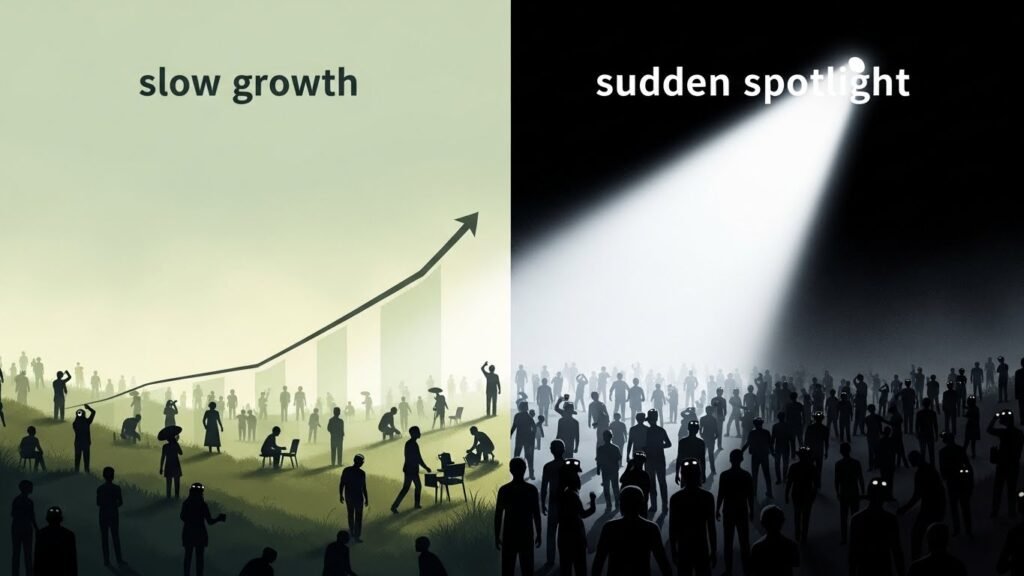
Fame development follows different temporal patterns across different cases. Some recognition builds progressively over extended periods while other fame emerges rapidly through concentrated visibility events.
Gradual recognition involves incremental awareness building over months or years. Small audiences grow larger through sustained activity and cumulative exposure. Each successive project, appearance, or content release adds marginally to total awareness until recognition reaches significant levels.
Steady career advancement characterizes many gradual fame development patterns. Progressive movement to larger platforms, more prominent positions, or wider distribution gradually expands audience reach. This measured growth allows adaptation to changing circumstances as visibility increases.
Sudden visibility involves rapid recognition expansion through concentrated high-impact exposure. Viral content, breakout performances, or exceptional events can generate widespread awareness within very compressed timeframes. Individuals may transition from obscurity to substantial recognition within days or weeks.
The digital media environment has increased possibilities for sudden visibility. Viral distribution can expose individuals to massive audiences rapidly when content achieves algorithmic amplification. This acceleration potential represents a distinctive feature of contemporary fame dynamics.
Hybrid patterns combine gradual and sudden elements. Extended periods of incremental growth may be punctuated by acceleration events that rapidly expand recognition. Alternatively, sudden visibility may be followed by gradual consolidation as initial awareness stabilizes into sustained recognition.
The recognition pattern affects experience and sustainability. Gradual development allows progressive adjustment while sudden visibility requires rapid adaptation. Neither pattern inherently produces more stable or lasting recognition, but they create different developmental experiences.
External Factors That Accelerate Fame

Beyond individual effort and capability, external factors significantly influence recognition development. Understanding how celebrities became famous includes identifying circumstances that accelerate or enable fame beyond what individual factors alone would produce.
Industry promotion and marketing resources amplify visibility beyond organic levels. When organizations invest resources in promoting specific individuals, recognition can develop faster and more extensively than unaided visibility would allow. Access to these promotional resources significantly affects fame trajectories.
Association with established famous individuals can accelerate recognition. Appearing alongside, collaborating with, or being endorsed by already-recognized figures transfers some awareness to previously unknown individuals. These association effects provide visibility shortcuts.
Media trend cycles can elevate individuals who align with current focus areas. When media attention concentrates on particular topics, fields, or types of content, individuals connected to those areas receive enhanced coverage. Alignment with trend cycles accelerates recognition.
Platform features and algorithmic promotion can rapidly expand visibility. When digital platforms feature or promote content, distribution expands beyond organic reach. Being selected for platform promotion provides recognition acceleration.
Newsworthy events create exposure opportunities. Involvement in situations that generate news coverage brings media attention that may not otherwise occur. These circumstantial exposure opportunities can significantly accelerate recognition development.
Cultural resonance accelerates audience adoption. When individuals connect with current cultural sentiments, values, or interests, audiences respond more enthusiastically. This resonance creates word-of-mouth amplification that accelerates recognition beyond what exposure alone would produce.
Why There Is No Single Formula for Fame

Despite identifiable patterns and mechanisms, no reliable formula exists for achieving fame. Examining how celebrities became famous reveals consistent elements but not predictable recipes.
Multiple pathways lead to similar recognition outcomes. Different individuals achieve comparable fame through entirely different routes. This pathway diversity demonstrates that fame can emerge through various combinations of factors rather than through single prescribed approaches.
Individual variations in capability, context, and circumstance mean that what works for one person may not work for another. Attempting to replicate another’s path typically fails because underlying conditions differ. Fame involves interaction between individual and environmental factors in ways that resist formulaic replication.
Timing and circumstance introduce unpredictability. Factors beyond individual control significantly influence outcomes. Market conditions, cultural moments, competitive contexts, and opportunity availability all vary in ways that affect results independently of individual effort or capability.
Luck and random variation play documented roles. Even controlling for all identifiable factors, variation in outcomes remains. This residual variation reflects genuinely unpredictable elements in how recognition develops.
Survivor bias distorts understanding of fame achievement. Examination typically focuses on those who achieved recognition while overlooking equally capable individuals who did not. This selective attention can create misleading impressions about the reliability of particular pathways.
The absence of formula does not mean absence of pattern. Common elements appear across different fame achievement cases even though no guaranteed recipe exists. Understanding these elements improves comprehension of how celebrities became famous without providing prediction or prescription.
Conclusion

The question of how celebrities became famous can be answered through examination of the systems, pathways, and mechanisms that generate public recognition. While no single formula guarantees fame, identifiable patterns characterize how widespread awareness develops.
Fame represents widespread public awareness achieved through transitions from obscurity to recognition. This transition involves measurable changes in media coverage, public discussion, and audience awareness that can be examined systematically.
Common pathways channel individuals toward recognition opportunities. Entertainment industry structures, athletic systems, digital platforms, and other organized contexts provide frameworks within which fame can develop. These pathways offer access to visibility-generating opportunities.
Talent and skill matter primarily through their visibility rather than their mere existence. The mechanisms that make capabilities visible to large audiences determine whether ability translates into recognition. Performance contexts, documentation technologies, and distribution systems create visibility that enables fame.
Media exposure fundamentally drives public awareness development. Traditional and digital media create and distribute content that exposes individuals to audiences. The cumulative effect of media exposure across platforms and time builds the recognition that constitutes fame.
Industry gatekeepers control access to fame-generating opportunities. Their decisions about who receives visibility-producing positions significantly influence who achieves recognition. Understanding gatekeeper functions illuminates opportunity structures within fame-generating industries.
Timing and cultural context shape recognition possibilities. When and where individuals seek fame affects their prospects due to varying cultural conditions, industry circumstances, and competitive dynamics. These contextual factors influence outcomes independently of individual effort.
External accelerating factors contribute to fame development beyond what individual factors alone produce. Promotional resources, associations, trend alignment, and platform promotion can all accelerate recognition.
The absence of a reliable fame formula reflects the complexity of recognition achievement. Multiple pathways, individual variation, circumstantial unpredictability, and random elements all contribute to outcomes. Understanding how celebrities became famous involves acknowledging both the patterns that exist and the uncertainty that remains.